
Oversized, medical and special baggage on a Galveston cruise transfer
Questions? Call us(409) 256-4583Medical equipment always travels at no charge. Bulky sports gear usually needs a private vehicle. Here is the item-by-item list, and what to declare when you book.
Every shared seat is protectedStandard cruise luggage is easy — one large bag and a carry-on per person, included on every shared seat, no per-bag fee. The questions that actually need answering are the ones about everything else. A CPAP machine. Golf clubs. A folded wheelchair alongside two suitcases. An oxygen concentrator. A stack of duty-free on the way home.
This page is a straight list of what fits where. The short rule underneath all of it: medical equipment always travels, sports and bulky gear usually needs a private vehicle, and anything unusual needs declaring at booking rather than discovered at the kerb.
The capacity you are working with
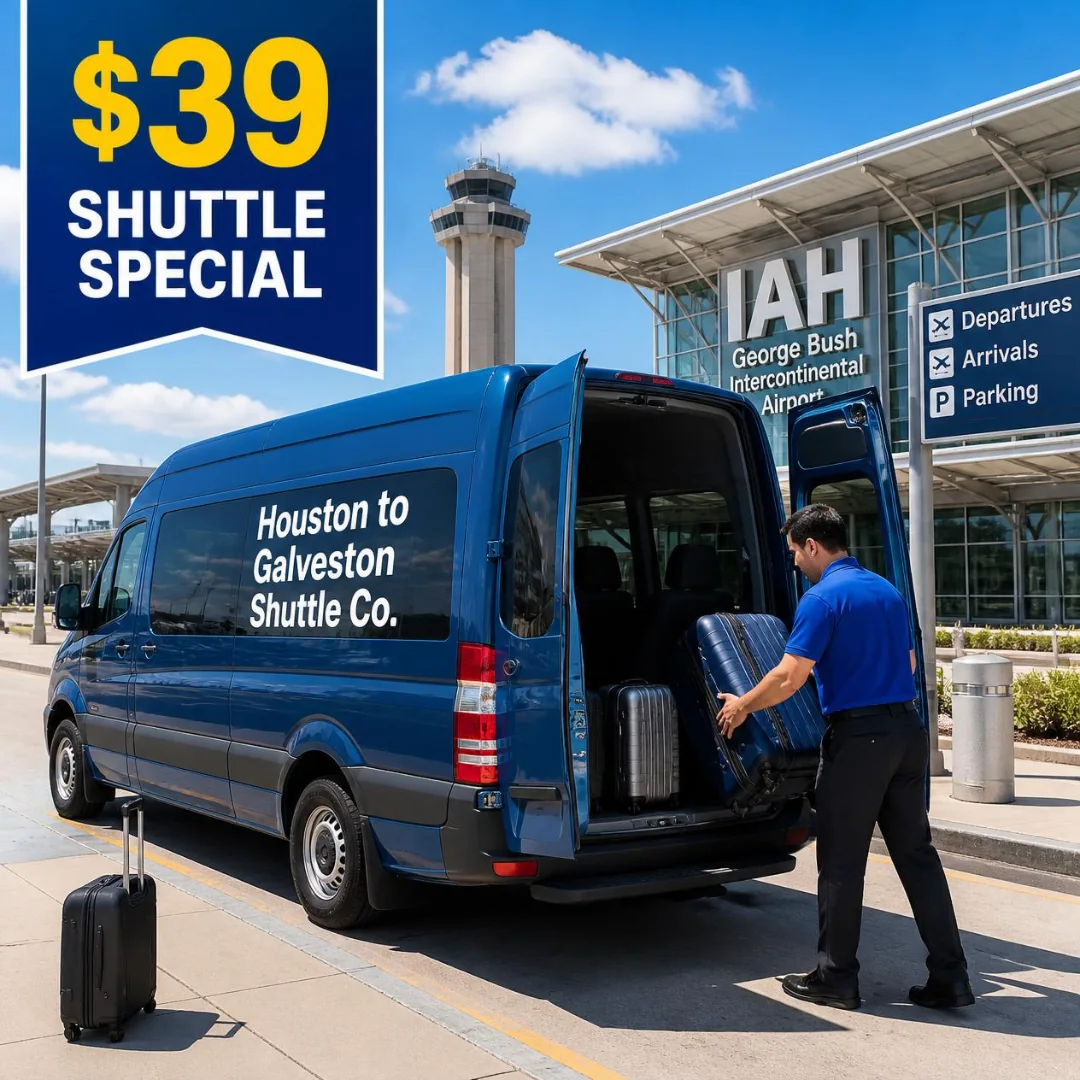
Space is the constraint, and it runs out before seats do.
| Vehicle | Passengers | Cruise bags | Room for extras |
|---|---|---|---|
| Shared seat | Per person | 1 standard bag each | Limited — declare anything extra |
| Black Suburban | 1 to 6 | 6 to 7 | Good at 4 passengers or fewer |
| 14-passenger Sprinter | 7 to 14 | 14+ | Best option for bulky items |
The useful way to think about it: count bulky items as passengers-worth of space. A golf travel bag is roughly two suitcases. A folded wheelchair is two to three. Once you convert your awkward items into suitcase-equivalents, the vehicle you need becomes obvious.
Medical equipment
Always carried, never charged extra, and it does not count against a standard luggage allowance. It is medical equipment, not baggage.
CPAP and BiPAP machines. Carried without question and they take very little space. Keep the machine in the cabin with you rather than in the hold — partly so it cannot go astray, partly because it is the item you would least want delayed if bags are slow off the ship on the return.
Portable oxygen concentrators. Carried. Tell us at booking so the driver knows, and keep the unit accessible rather than packed. If you need to use it in transit that is entirely fine; the drive is 40 to 70 miles depending on the airport, so it is not a short run.
Nebulisers, insulin coolers, medication. All carried, all in the cabin with you. Do not put temperature-sensitive medication in the luggage compartment on a Gulf coast summer day.
Folded wheelchairs, walkers, rollators and canes. Carried. A folded manual chair fits alongside luggage on a Suburban or a Sprinter without difficulty. What needs declaring is the combination — a chair plus a full complement of cruise bags for four people is where space gets tight, and it is better to know that in advance and send the right vehicle.
Mobility scooters and powered wheelchairs. This is where you must speak to us before booking rather than after. A powered chair or a scooter is heavy, does not fold in the way a manual chair does, and is not something to discover at a kerb on a sailing morning. Contact us with the make and folded dimensions and we will tell you plainly what works. We would rather turn a booking away than have you standing at the terminal with equipment we cannot carry.
Sports and hobby equipment
Golf clubs. A hard travel case is long and takes the space of about two suitcases. One set alongside two passengers on a Sprinter is fine. Two sets plus a full luggage load needs planning. Declare them.
Scuba gear. The bag itself is manageable; the issue is weight and bulk together, particularly with a BCD and regulators. Tanks are a different matter — most airlines will not carry them and most cruise lines have their own rules, so travellers usually rent at destination rather than transporting them. If you are genuinely moving tanks, tell us and we will discuss it.
Fishing rods. Length is the constraint rather than weight. Tubed rods travel fine in a Sprinter. Ask about a Suburban.
Surfboards and paddleboards. Not on a shared seat. Depends on length for a private vehicle, and a long board may not work at all. Ask before booking.
Bicycles. Boxed or bagged, effectively a private-vehicle item and one that needs discussing. A packed bike is bigger than most people expect.
Family and baby equipment
Strollers. A folded umbrella stroller is roughly a carry-on. A full travel system with a car seat base is closer to a large suitcase. Both travel; the second one needs declaring on a shared seat. More on this in car seats and traveling with young children.
Car seats you are bringing yourself. Carried, and worth telling us so the driver allows fitting time. We also supply seats at $15 each way, which is usually easier than carrying your own through two airports.
Travel cots and pack-and-plays. Bulky for their weight. Fine in a Sprinter, declare for anything smaller.
The awkward miscellaneous
Wedding dresses and garment bags. Carried flat where possible. Say so at booking and the driver will load them last rather than under the suitcases.
Musical instruments. A guitar is straightforward. A cello is a private vehicle and a conversation. Anything in a hard case that you would not want compressed needs mentioning.
Coolers. A soft cooler is a bag. A large hard cooler is two suitcases and frequently a surprise to the person bringing it.
Duty-free and shopping on the return. The leg people forget. You board the ship with two bags and come home with two bags plus a case of tequila and a box of souvenirs. That extra volume is real, so if you know you shop, book the return with a little more room than the outbound.
Wheelchairs plus luggage plus a full party. The most common genuine capacity problem we see. Not because any single item is difficult, but because the combination adds up past what a vehicle holds. This is exactly the case for declaring everything.
Why declaring it matters more than the fee
There is no surcharge for most of this. So the reason to tell us is not price — it is that the vehicle dispatched to you is chosen when you book.
A driver arriving in a Suburban for a party of four with two golf bags and a wheelchair cannot solve it at the kerb. There is no larger vehicle waiting nearby on a cruise morning. The options at that point are leaving something behind or waiting for a second vehicle, and neither is a good outcome an hour before your boarding deadline.
Tell us at booking and the right vehicle comes. It costs you nothing and it removes the only version of this that ends badly.
Shared seat or private, by what you are carrying
| What you are bringing | Shared seat | Better option |
|---|---|---|
| Standard bags only | Yes | Shared is fine |
| CPAP, medication, cane | Yes | Shared is fine |
| Folded manual wheelchair | Declare it | Usually fine either way |
| Oxygen concentrator | Declare it | Usually fine either way |
| One set of golf clubs | Declare it | Private is easier |
| Scuba kit, boards, bicycles | No | Private, after a conversation |
| Powered chair or scooter | No | Not carried on either service |
| Wheelchair plus a full party's luggage | No | Sprinter |
Private rates are per vehicle rather than per person, so for a group carrying awkward items the maths is often better than expected — $249 from Hobby for a Suburban carrying up to six, or from $590 for a 14-passenger Sprinter. Full rates on the rates page, and the fleet page lists what each vehicle holds.
How to describe an item so we can answer quickly
Most enquiries about unusual baggage take two or three exchanges because the first message does not contain enough to answer. Four details settle almost anything:
- What it is, specifically. "A wheelchair" covers a folding manual chair and a 200-pound powered chair, and those are completely different answers.
- Folded dimensions, roughly. Length matters more than weight for most items, because vehicles are constrained by shape rather than mass.
- How many passengers and how many standard bags are traveling with it. The item alone is rarely the problem; the combination usually is.
- Whether you need it during the drive. An oxygen concentrator you will use in transit is loaded differently from one that can go in the back.
Send that and you will get a straight answer in one reply. Contact details are here, and if the answer is that we cannot carry something, we will say so rather than hedging — a wasted journey on a sailing morning is worse for you than a declined booking.
What we will not carry
Short list, for completeness. Anything prohibited by law or by your cruise line. Anything that cannot be secured safely in a passenger vehicle. Fuel, compressed gas other than medical oxygen, and open containers of alcohol.
Pets are a separate question with its own answer, and service animals are treated differently from pets. If either applies, ask before booking rather than assuming — it is not something to resolve at a kerb.
None of that list is unusual. It is here because "can you carry X" deserves a real answer rather than a maybe, and knowing the boundaries is more useful than a page that implies everything is fine.
Do not forget the cruise line's rules
Getting something to the terminal is only half the problem. Cruise lines have their own restrictions, and they are stricter than ours in several places — alcohol allowances, prohibited items, and rules for powered mobility devices in cabins and on tenders.
We can carry something the ship will not let aboard, which is a wasted journey for everyone. So check your cruise line's policy alongside ours. On a Carnival, Royal Caribbean or MSC sailing, the line's own site is the authority on what boards.
The return leg, and why it is different
Bags come off the ship in waves on debarkation morning and you may collect them later than you expect. Two consequences for anything unusual.
Keep medical equipment in the cabin with you rather than in checked luggage, so a delayed bag is not a medical problem. And build in the shopping — the volume coming home is frequently greater than the volume going out. Book the return at the same time as the outbound, since a late ship arrival that causes you to miss a return pickup refunds your shared booking under Shuttle Protection. The return trip page covers timings.
Telling us in advance is the whole trick
Nearly every awkward moment with unusual baggage traces back to the same thing: the item was not mentioned until the vehicle arrived. At that point the options are poor, because the space either exists or it does not.
Mentioned at booking, it is a scheduling question and we solve it before you pay — by allocating the space, or by telling you a larger vehicle is needed and what that costs. Mentioned at the kerb, it becomes your problem on the morning you least want one. There is no penalty for declaring an item, and no advantage to leaving it as a surprise.
If you are unsure whether something counts, it probably does. Anything that will not sit flat in a car boot, anything rigid, and anything you would describe as awkward rather than heavy is worth a line in the booking notes or a quick word with us on contact before you reserve.
The bottom line
Medical equipment always travels, at no charge and outside your luggage allowance. Bulky sports gear usually means a private vehicle. Powered mobility devices and scooters are not carried on either service.
Whatever it is, declaring it at booking costs nothing and determines which vehicle turns up. That is the whole point — not the fee, the vehicle.
If you take one thing from this page, make it the suitcase-equivalent habit. Before you book, add up what you are carrying in suitcase units rather than item counts: four bags, plus a golf case at two, plus a folded chair at two, is eight units for a party of four. That is a Sprinter, not a Suburban, and knowing it in advance is the difference between a normal morning and a bad one.
Houston to Galveston distance
Oversized and medical baggage: common questions
Yes. CPAP and BiPAP machines are carried at no charge and do not count against a standard luggage allowance. Keep the machine in the cabin with you rather than in the luggage compartment, so it cannot go astray and is not delayed if bags are slow off the ship on the return.
Yes, at no charge. Tell us at booking so the driver knows, and keep the unit accessible rather than packed. Using it in transit is fine — the drive is 40 to 70 miles depending on which airport you start from.
Yes, but declare them. A hard golf travel case takes roughly the space of two suitcases. One set alongside two passengers in a Sprinter is comfortable. Two sets plus a full luggage load needs the right vehicle chosen in advance.
We cannot carry them. Powered chairs and scooters are heavy, do not fold like a manual chair, and will not fit our vehicles. Book with a wheelchair-accessible transportation provider instead. We would rather tell you now than leave you at the terminal with equipment we cannot carry.
There is no surcharge for medical equipment, and most other items carry no fee either. The reason to declare something is not cost — it is that the vehicle sent to you is chosen at booking, and a driver cannot fix a capacity problem at the kerb on a cruise morning.
Yes. A folded manual chair fits alongside luggage in a Suburban or a Sprinter. What needs declaring is the combination — a chair plus a full set of cruise bags for four people is where space gets tight, so tell us and the right vehicle is sent.
Not on a shared seat. These are private-vehicle items and need a conversation first, because length and bulk vary enormously. Scuba tanks in particular are usually rented at destination rather than transported, since airlines and cruise lines have their own restrictions.
Ready to book your ride?
Reserve your $39 protected seats in about two minutes, or call 409.256.4583 for a private quote.
Book shuttle