
Car seats and traveling to Galveston with young children
Questions? Call us(409) 256-4583You do not need to bring your own. Seats are $15 each way, fitted before we arrive. Here is what Texas law requires and how to choose between shared and private.
Every shared seat is protectedYou are flying into Houston with a two-year-old, sailing out of Galveston the next morning, and you are trying to work out whether you have to drag a car seat through two airports to cover a 90-minute drive. It is one of the most-asked questions we get from families and one of the least-answered anywhere online.
The short answer: you do not have to bring your own. Child safety seats are $15 each way and are fitted in the vehicle before you arrive, provided you request them when you book. Whether the law strictly requires one depends on the vehicle, and that distinction is worth understanding before you decide.
What Texas law actually says
Texas requires children under eight years old to be secured in a child passenger safety seat system unless they are taller than four feet nine inches. That is the headline rule and it applies to ordinary passenger vehicles.
The part almost nobody explains is that the requirement is written around passenger vehicles, and certain commercial passenger operations are treated differently. This is why you have never been asked to install a car seat on an airport shuttle bus, in a taxi in most cities, or on a hotel courtesy van — and why parents arrive genuinely unsure what applies to a shuttle.
Rather than lean on that distinction, our position is simpler: we carry seats, we fit them, and we would rather your toddler travelled in one on Interstate 45 regardless of how the statute treats the vehicle class. A 90-minute run down I-45 at highway speed is not the trip to be relaxed about.
Confirm the current statute for yourself if the legal position matters to your decision. Traffic law changes, and this page is a practical guide rather than a legal one.
What we provide, and what it costs
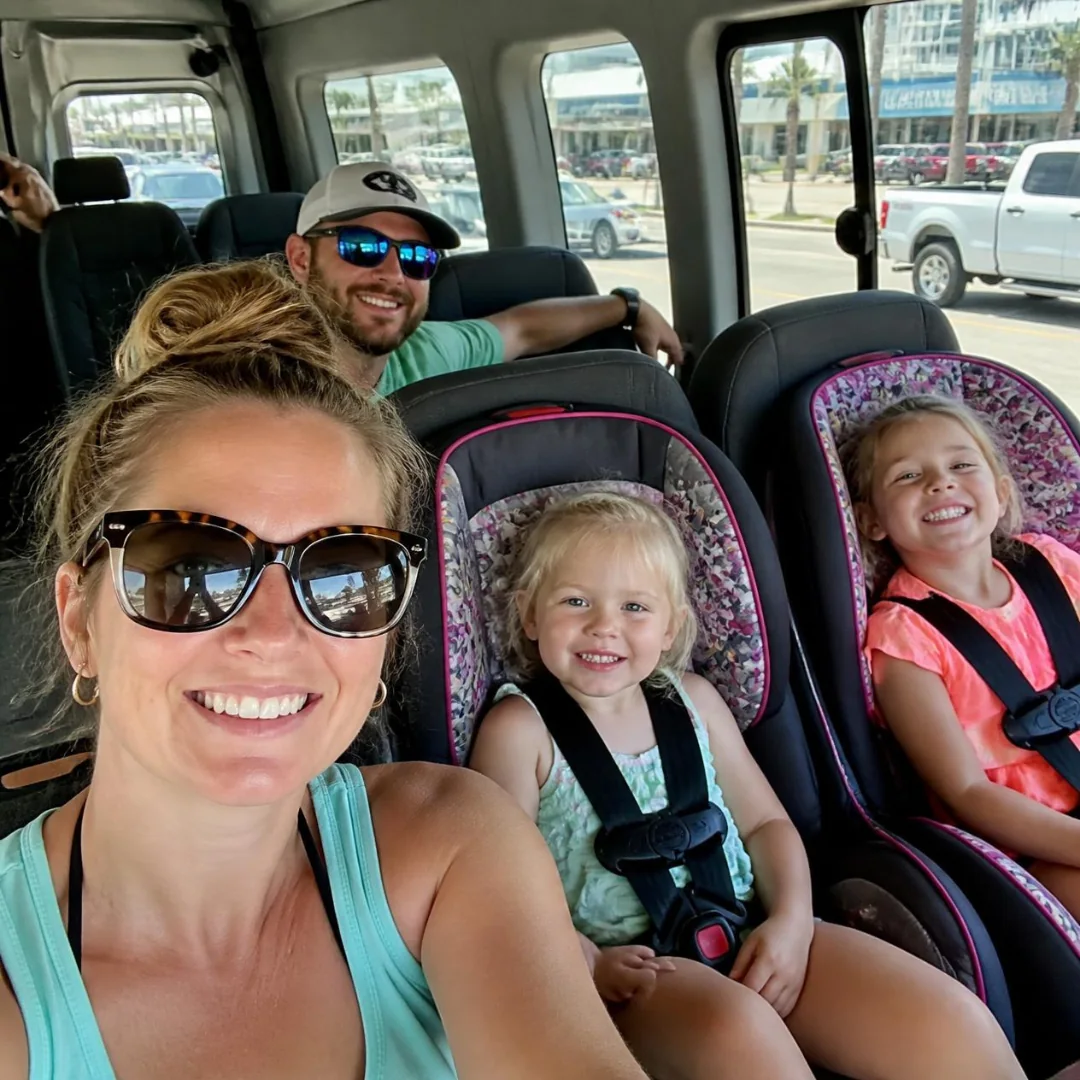
Three seat types are available, at $15 each way per seat:
- Infant seat — rear-facing, for the smallest passengers.
- Toddler seat — forward-facing with a harness.
- Booster seat — for older children who have outgrown a harness but not the seatbelt height.
They have to be requested at booking. This is not an upsell mechanism — it is that the seat has to be physically in the vehicle that comes for you, and the driver dispatched to your pickup cannot conjure one at the kerb. Add them when you reserve and they are fitted before arrival. The rate is confirmed at booking alongside your fare on the rates page.
Each seat occupies a passenger seat, which matters for capacity. Two adults and two children in seats is four passengers, not two. If your party is close to a vehicle's limit, count the children.
Do you need to bring your own?
No, and for most families flying in, bringing one is the worse option. Consider what it actually involves: checking or gate-checking a bulky item, collecting it at baggage claim, carrying it to the pickup point, then having it with you for the entire cruise.
That last part is the one people forget. A car seat you bring for the transfer does not disappear once you board. It goes into your stateroom for seven nights and comes back with you. Cabins on most Galveston-based ships are not generous with floor space.
There are two reasons to bring your own anyway, and they are both legitimate:
- Your child is used to their own seat. With an anxious toddler, familiarity buys you a quieter drive. That is worth something.
- You have a specialist or medical seat. If your child uses a positioning seat or an adapted restraint, bring it — we cannot substitute for that.
If you do bring your own, tell us at booking so the driver knows to allow time for fitting. Installing an unfamiliar seat properly at an airport kerb takes a few minutes, and those are minutes you do not want to be finding on a sailing morning.
Shared shuttle or private with young children?
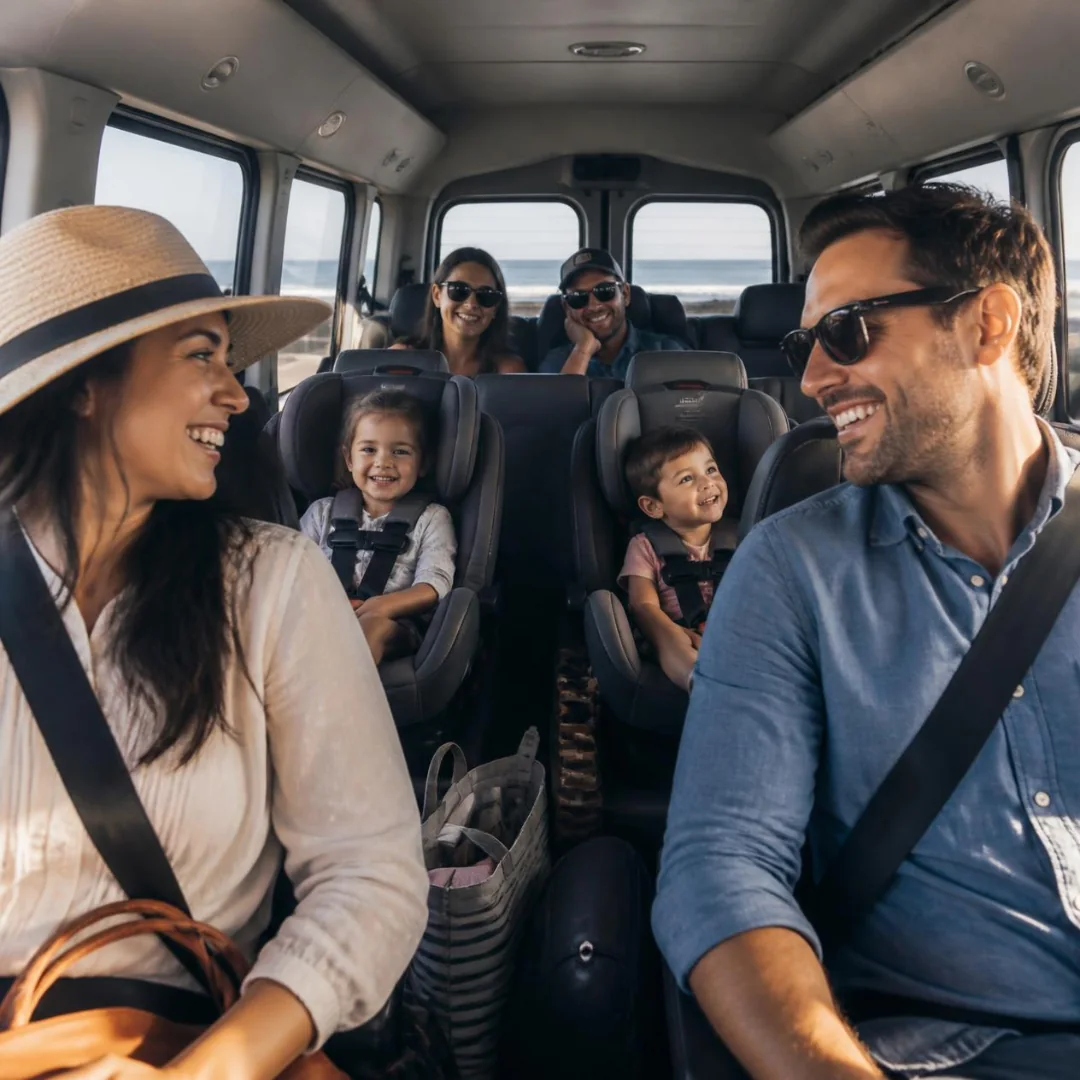
This is the decision that matters more than the car seat itself, and the honest answer depends on the age of your children rather than your budget.
Shared seats work well when
Your children are school age or older, you are flying into IAH or Hobby, and the priority is cost. Four shared seats from Hobby is $156 against $249 for a private Suburban, so shared is meaningfully cheaper. Each shared seat includes one checked bag and one carry-on, and every seat carries Shuttle Protection — which matters more with children than without, because a family of four missing a pickup after a delayed flight is $156 lost rather than $39.
Private is worth it when
Your children are under about four. A shared van collects several parties and serves multiple terminals, so the journey is longer than the drive — and the difference lands hardest on the smallest passengers. A private black car goes from your door to your ship with nothing in between. For a family with a toddler and an infant, the $249 private rate buys a materially different trip, not just a nicer one.
Private also collects from any address rather than airports only, which is the deciding factor if you are starting from a hotel or a relative's house. Our private versus shared comparison covers the break-even in general terms; with young children the calculation tilts earlier than the pure arithmetic suggests.
Which option fits your children's ages
Rather than a general recommendation, here is how the choice actually falls by the age of the youngest passenger. Rates are from Hobby Airport for a family of four; IAH is $257 for a Suburban and shared seats are the same $39 from either.
| Youngest child | What matters most | Usually the better fit | Cost, family of four |
|---|---|---|---|
| Under 2 | Rear-facing seat, feeding, no multi-stop route | Private Suburban | $249 per vehicle |
| 2 to 4 | Attention span, bathroom access, nap timing | Private Suburban | $249 per vehicle |
| 5 to 8 | Booster seat, tolerable with distraction | Either | $156 shared / $249 private |
| 9 and older | Cost, luggage allowance | Shared seats | $156 shared |
The pattern is that the private premium — $93 for a family of four from Hobby — buys the most for the youngest passengers and progressively less as children get older. By nine or ten, a shared van is simply a bus ride and the money is better spent elsewhere.
Landing in Houston with children before a sailing
The airport half of the day shapes the transfer more than the transfer itself, and the two airports present different problems for families.
Hobby is the smaller of the two and about 40 miles from the port, which is the shorter drive by roughly half an hour. IAH is about 70 miles out and considerably larger — five terminals connected by a Skyway train, and international arrivals clear customs in Terminal D or E before reaching baggage claim. With small children and a stroller, that walk and that train are the part to plan for, not the drive. There is more detail in our comparison of the closest airport to the Galveston cruise port.
The bigger question for families is whether to fly in on the sailing day at all. With one adult, a same-day arrival is a manageable risk. With children, a delay cascades: a missed nap becomes a difficult afternoon, and a late bag becomes a boarding-queue problem. Our piece on whether it is worth staying in Galveston the night before covers the general argument, and it applies more strongly with young children than without. If you are landing late the night before, read red-eye and overnight arrivals at IAH.
Whatever you decide, book the transfer for the flight you are actually on rather than the one you hope for. Every shared seat is protected against a delayed or cancelled inbound flight, so booking the realistic option costs you nothing if the airline lets you down.
Strollers, and how they affect your luggage
Bring the stroller. Galveston terminals involve more walking than you expect between drop-off and check-in, and a tired four-year-old at the back of a boarding queue is a problem you can solve in advance.
What to know about space: a folded umbrella stroller is roughly a carry-on. A travel system with a detachable car seat base is roughly a large suitcase. On a shared seat, the luggage allowance is one standard cruise bag per person, so a bulky travel system needs declaring at booking rather than appearing at the kerb.
Most cruise lines allow strollers on board and many families gate-check them for the flight, so the stroller usually travels with you regardless. The question is only whether we know it is coming.
The practical stuff nobody puts on a website
The drive is 40 to 70 miles depending on which airport you land at — about 40 from Hobby, about 70 from IAH. Allow around an hour from Hobby and up to two on a shared route from IAH. That is a long stretch for a toddler with nothing to do.
There is no scheduled comfort stop. On a private transfer, ask the driver — a brief stop is usually workable. On a shared van with other parties aboard and a boarding window to hit, it is not something to count on. Use the airport bathroom before you leave, even if nobody claims to need it.
Feed them before you get in. Not a rule, just experience. The stretch of I-45 between Houston and Galveston has little to look at, and hungry is the wrong state to start it in.
Bags go in the back, not with you. Keep the nappy bag, snacks, wipes and one toy in the cabin with you. Everything else is loaded and inaccessible until Galveston.
Book the return at the same time. Debarkation morning with children is harder than embarkation — everyone is tired, the terminal is crowded, and thousands of people leave within two hours. The return trip is the leg families most often forget, and rideshare availability at the terminals in that window is unreliable.
Counting your party correctly
Children occupy seats, and that changes which vehicle you need. A Suburban carries six passengers, a Sprinter fourteen. Two adults, three children and a baby is six passengers — a full Suburban, not a family of two with extras.
Luggage runs out before seats do with a family, because children generate bags disproportionately. Two adults and three children on a seven-night sailing is commonly five checked bags, a stroller, and a stack of hand luggage. Say so at booking. If your party is larger, transportation for 10 or more passengers works through capacity by party size, and the fleet page lists what each vehicle holds.
The bottom line
You do not need to bring a car seat. Request one at booking, $15 each way, and it is fitted before the vehicle reaches you. Bring your own only if your child needs their familiar seat or uses a specialist restraint — and remember it lives in your cabin for the whole cruise.
If your children are small, the more consequential decision is private over shared. Not because shared is unsuitable, but because a direct 90-minute run beats a multi-stop route by a margin that matters when the passenger is three years old.
One last thing worth saying, because it is the mistake families make most: book the return leg at the same time as the outbound. Debarkation morning is the harder of the two days — everyone is tired, several thousand people clear the terminals inside about two hours, and rideshare supply on the island in that window is the thinnest it gets all week. A family of five trying to assemble transport at 8am on a Sunday at the Galveston cruise terminal is not a position you want to be in. Book both directions, and the morning becomes somebody else's problem.
Houston to Galveston distance
Car seats and traveling with children: common questions
No. Child safety seats are available at $15 each way and are fitted in the vehicle before you arrive, provided you request them when you book. Bring your own only if your child needs their familiar seat or uses a specialist or medical restraint.
$15 each way per seat. Infant, toddler and booster seats are available. They must be requested at booking so the seat is physically in the vehicle dispatched to you.
Texas requires children under eight to be in a child passenger safety seat unless they are taller than four feet nine inches, and that rule is written around passenger vehicles. Certain commercial passenger operations are treated differently, which is why shuttle buses and taxis are not usually asked for them. We carry and fit seats regardless. Confirm the current statute yourself if the legal position matters to your decision.
If your children are under about four, private is worth the difference. A shared van collects several parties and serves multiple terminals, so the journey runs longer than the drive itself. School-age children travel fine on shared seats, and four shared seats from Hobby is $156 against $249 for a private Suburban.
Yes, and you should. A folded umbrella stroller is roughly a carry-on in space terms, while a travel system with a car seat base is closer to a large suitcase. Declare a bulky stroller at booking. The shared allowance is one checked bag and one carry-on per person, and private is one checked bag and one personal item per person.
Yes. Every child occupies a seat, and a fitted child seat occupies one too. Two adults, three children and a baby is six passengers, which fills a Suburban.
Not scheduled. On a private transfer you can ask the driver and a brief stop is usually workable. On a shared van with other parties aboard and a boarding window to meet, do not count on it. Use the airport bathroom before departure.
Ready to book your ride?
Reserve your $39 protected seats in about two minutes, or call 409.256.4583 for a private quote.
Book shuttle