
Red-eye and overnight arrivals at IAH before a morning sailing
Questions? Call us(409) 256-4583You land at 11:40pm and sail at noon, seventy miles away. Here is how to spend the hours in between, and how to book the transfer so a delay does not cost you.
Every shared seat is protectedYour flight lands at Bush Intercontinental at 11:40pm. Your ship boards at noon the next day, seventy miles south. Every article about Galveston cruises tells you to fly in the day before — but you have, technically, and it has left you with a problem nobody writes about.
This page is for the traveller who cannot arrive at a civilised hour: the international connection that lands near midnight, the award ticket that was the only seat available, the red-eye that was two hundred dollars cheaper. You have between six and twelve hours to fill in a city you did not plan to spend the night in, and then a transfer to make.
The two real options

There are only two, and the choice comes down to how many hours you actually have.
Wait it out at the airport and take an early transfer straight to the port. Costs nothing beyond food, and it means one journey rather than two. Viable if your gap is short and you can sleep sitting up.
Take an airport hotel for a genuine few hours of sleep, then transfer in the morning. Costs a night's rate for a fraction of a night, and adds two short journeys at either end.
The dividing line sits at roughly six hours. Below that, by the time you have cleared baggage, reached a hotel, checked in, slept, and come back, you have gained very little. A hotel for four hours is an expensive shower. Above eight hours, the hotel usually wins — you will board your ship having slept in a bed, and embarkation day is long.
What an overnight wait at IAH is actually like
Worth knowing before you commit to it. Bush Intercontinental is not a 24-hour airport in the way Doha or Singapore is. Overnight it becomes a much quieter building: most retail and food closes, and the terminals thin out considerably in the small hours.
The airport has five terminals, A through E, connected by a Skyway train, and international arrivals clear customs in Terminal D or E before reaching baggage claim. Budget 45 to 60 minutes from wheels-down to kerb on an international arrival — more if you land into a busy bank of flights. That eats into your gap before you have even started waiting.
Practical notes if you choose to stay:
- Check what is open before you settle. Overnight food and seating options vary by terminal, and moving between terminals with luggage at 3am is a chore worth doing once rather than twice.
- Stay landside once you have your bags. Once you have cleared baggage claim you cannot easily return to the secure area, and there is no reason to.
- Charge everything. You will need a phone in the morning to reach your driver, and outlets are less abundant than you would like.
- Keep your documents on you. Passports, cruise documents, and your transfer confirmation stay in a bag that does not leave your body.
None of this is unmanageable. It is simply a different proposition from a four-hour daytime layover, and it is worth going in with accurate expectations rather than discovering them at 2am.
The airport hotel option
There are a number of hotels within a short shuttle ride of the IAH terminals, and most run their own courtesy transport. For a gap of eight hours or more this is usually the better call, for one reason that has nothing to do with comfort: embarkation day is physically long. You will be on your feet in queues, then walking a ship. Starting that having slept in a chair is a poor trade for a saved hotel rate.
Two things to watch. First, check the hotel actually runs its shuttle at the hour you land — several suspend overnight service, which turns a free transfer into a paid one at midnight. Second, confirm you can check in on arrival rather than at a stated afternoon time; not every property will hand you a room at 1am without a prior night booked.
If you would rather sleep closer to the ship than to the airport, the alternative is to transfer to Galveston that night and take a hotel on the island instead. That costs a late-night transfer but means you wake up minutes from the terminal. Our Galveston park and cruise hotels page covers what is near the port, and whether it is worth staying in Galveston the night before makes the broader case.
Booking a transfer around a red-eye
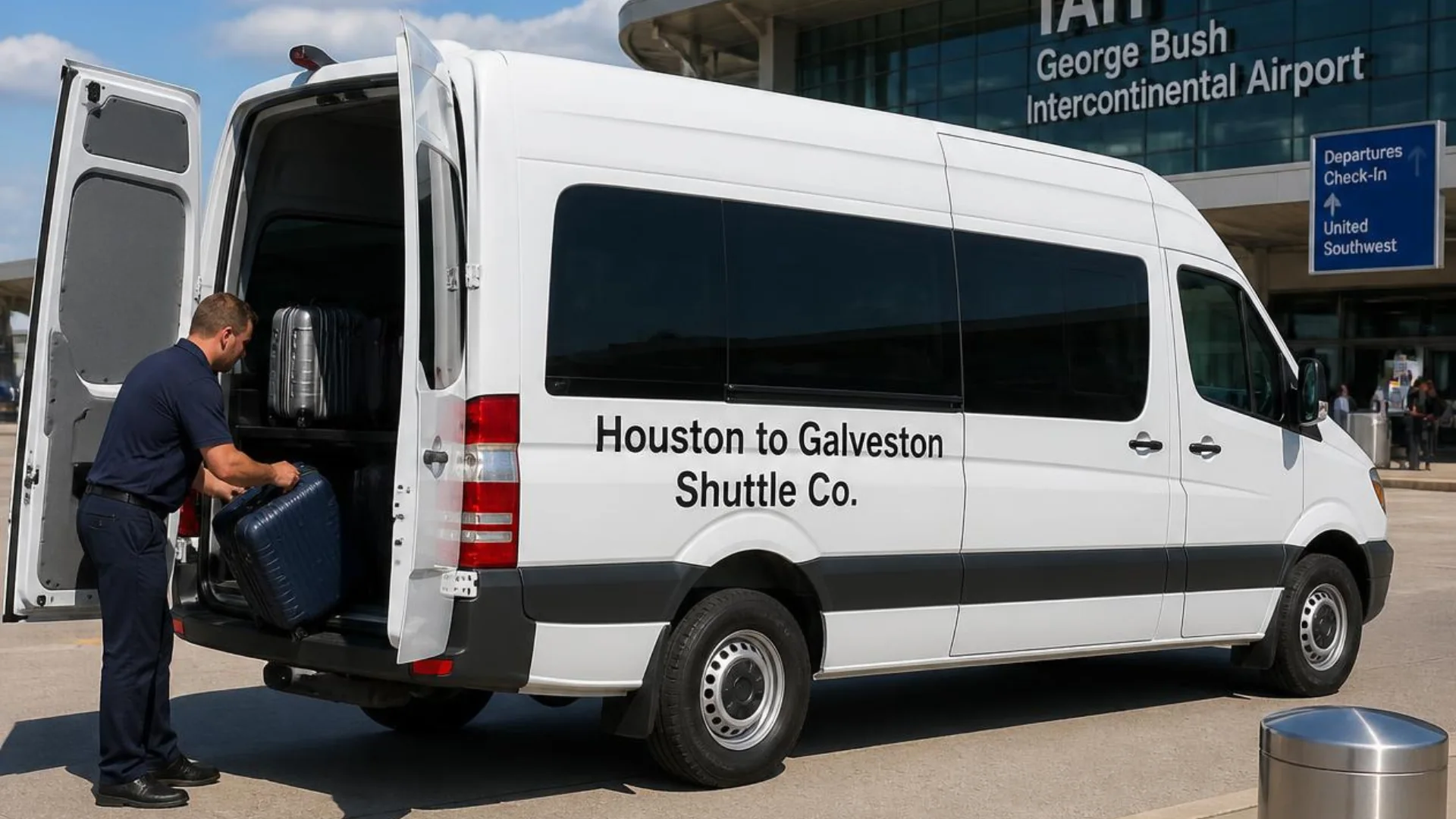
Here is the part that trips people up. There is a difference between booking a transfer for tonight — meeting your late arrival — and booking one for tomorrow morning after you have slept somewhere.
If you are transferring straight from the airport after landing, the pickup is tied to your flight. If you are staying overnight in Houston first, the pickup is tied to the morning and to wherever you slept. Those are different bookings with different pickup points, and getting them confused is the most common error on this kind of itinerary.
Two things make the late-arrival version safer than it sounds:
Flight tracking on private transfers. On a private airport pickup we track the inbound flight, so the driver works from your actual arrival rather than the scheduled one. On a red-eye that matters. Shared seats are not flight-tracked, so on a shared booking call us as soon as you know about a delay.
Protection. Every shared seat includes Shuttle Protection at no extra cost. If a delayed or cancelled inbound flight causes you to miss your pickup, the fare is refunded rather than lost — and you can cancel for any reason up to two hours before pickup. On a red-eye itinerary, where the odds of disruption are simply higher, that is the difference between a bad night and a bad night that also costs you money.
Shared seats run from the two airports only, on a schedule. If your gap means you need to leave at an hour outside that schedule, or you are starting from a hotel rather than a terminal, a private transfer is the option — fixed rate, any address, any time you set.
Landing at Hobby instead of IAH
Most red-eyes and international connections into Houston land at Bush Intercontinental, but if yours arrives at Hobby the calculation shifts in your favour on two counts.
Hobby is about 40 miles from the cruise port against roughly 70 from IAH, which is around half an hour less driving. It is also a considerably smaller building, so the walk from gate to kerb is short and there is no Skyway train and no inter-terminal transfer to factor in. On a tired night, the smaller airport is genuinely easier.
What Hobby does not give you is more overnight amenity — it is a quieter building overnight than IAH, not a busier one. So if you are choosing between waiting it out and a hotel, the six-hour rule applies just the same. The comparison of the two airports goes through the trade-off in full.
The morning after: what to expect at the port
One thing that surprises people who arrive early after a rough night is that early does not always mean straight on board. Terminals operate check-in windows, and arriving hours before yours can mean waiting in a building rather than a bed.
That cuts both ways. If you have been awake since a midnight landing, arriving at the terminal at 9am for a 1pm window is four more hours upright. Sometimes the better plan is a later transfer and a longer sit at the airport, where at least you know what is open. Sometimes it is the reverse, because the port has the sea air and your ship in front of you. It depends on your check-in time, which is on your cruise documents rather than something we can guess. Cruise-day arrival timing covers what each window actually involves, and arriving early at the Galveston cruise port covers what there is to do if you land at the terminal ahead of your slot.
Working the timing backwards
Do not start from your landing time. Start from your boarding window and work backwards, because that is the only fixed point in the day.
From IAH the drive is about 70 miles. A direct private run is roughly an hour and fifteen minutes; a shared route that collects several parties and serves multiple terminals runs closer to two hours. Add your buffer on top of that, not inside it. Our guidance on how early to leave Houston works through the arithmetic in full, and cruise-day arrival timing covers what the port end of the morning actually involves.
One adjustment specific to a red-eye: build in more buffer than you would when rested, not less. Tired people move slower, forget things, and misplace documents. The instinct after a bad night is to squeeze the morning so you can sleep another hour. That is exactly backwards.
Should you just fly in two days early instead?
Worth asking honestly. If the red-eye exists because it was the cheapest fare, price the alternative properly before you commit. A daytime flight the previous day plus one hotel night is often close in total cost to a red-eye plus an airport hotel plus a fraught morning — and it is a completely different experience of the day you sail.
If the red-eye exists because it is the only realistic connection from where you are starting, then it is not really a choice, and the rest of this page is how to make it work. International arrivals into IAH in particular tend to land in the evening for onward connection reasons, and there is often no earlier option.
The two options side by side
| Gap after landing | Wait at IAH | Airport hotel | Galveston hotel |
|---|---|---|---|
| Under 6 hours | Best option | Little gained | Not worth the late transfer |
| 6 to 8 hours | Workable | Usually better | Good if you want to wake near the ship |
| Over 8 hours | Hard on embarkation day | Best option | Best option |
| Extra cost | Food only | A night's rate | A night's rate plus a late transfer |
| Journeys involved | One, to the port | Two short, then one long | One long tonight, one short tomorrow |
The third column is the one most people never consider, and for a long gap it is often the best of the three: transfer to the island tonight, sleep near the port, and wake up minutes from your terminal instead of seventy miles away.
If it goes wrong
Two failure modes are worth planning for in advance rather than at 1am.
Your flight is badly delayed and lands in the small hours. With flight tracking, the pickup moves with the flight. If the delay is severe enough that the transfer no longer works, a shared fare is refundable rather than forfeited — so the decision is about logistics, not about money already spent.
Your flight is cancelled and you land on the morning of the sailing. This is the genuinely dangerous version, and it is why the day-before rule exists. A cancelled flight is refundable on a shared booking, but the ship will not wait. If you find yourself in this position, the priority is the cruise line rather than the shuttle — and our piece on missing your ship in Galveston covers what to do next.
The bottom line
Under six hours, stay at the airport and take an early transfer. Over eight, take a hotel — near IAH if you want the shorter hop, on Galveston Island if you would rather wake up near the ship. Book the transfer for the leg you are actually taking, tie it to your flight if it is an airport pickup, and give yourself more morning buffer than feels necessary.
A midnight landing before a noon sailing is entirely doable. It just needs deciding in advance rather than in an arrivals hall.
Houston to Galveston distance
Overnight arrivals at IAH: common questions
Shared seats run on a published schedule from both Houston airports. If your gap after a late-night arrival means you need to leave outside those hours, a private transfer runs at any time you set from any address, at a fixed rate.
The dividing line is roughly six hours. Below that a hotel gains you very little once you account for clearing baggage, checking in, and coming back. Above eight hours the hotel usually wins, because embarkation day is physically long and starting it without sleep is a poor trade.
Shared seats run to a schedule from the airports. A private transfer runs at any hour from any address, so a late-night run to an island hotel is possible if you would rather sleep near the ship than near the airport.
On a private airport pickup, yes. The driver works from your actual arrival rather than the scheduled one, which matters more on a red-eye. Shared seats are not flight-tracked, so call us if your flight is delayed.
Every shared seat includes Shuttle Protection at no extra cost. A delayed or cancelled inbound flight that causes you to miss your pickup is refunded, and you can cancel for any reason up to two hours before pickup.
Budget 45 to 60 minutes from landing to kerb, and more if you arrive into a busy bank of flights. International arrivals clear customs in Terminal D or E before reaching baggage claim, so that time comes out of your gap before the wait even starts.
About 70 miles. A direct private run is roughly an hour and fifteen minutes. A shared route that collects several parties and serves multiple terminals runs closer to two hours, so add your buffer on top of that rather than inside it.
Ready to book your ride?
Reserve your $39 protected seats in about two minutes, or call 409.256.4583 for a private quote.
Book shuttle