
Is there a bus or train from Houston to Galveston?
Questions? Call us(409) 256-4583The short answer: no train reaches Galveston Island, and no direct scheduled bus runs from Houston to the cruise terminals. Here is exactly what does exist, and what to do instead.
Every shared seat is protectedIt is the first thing almost everyone checks. Two cities, fifty miles apart, one of them a major American metro with a busy airport and the other the fourth-busiest cruise homeport in North America. There must be a bus. There must be a train.
There is not. Not a direct one, not a scheduled one, and not one that will put you and two suitcases at a cruise terminal in time for boarding. This page explains exactly what public transport does and does not exist on this route, what the least-bad transit attempt actually looks like end to end, and what the realistic alternatives cost.
The short answer

There is no passenger train to Galveston Island and no direct scheduled intercity bus from Houston to the Galveston cruise terminals. Galveston has a local transit system that runs on the island itself, and Houston has a large metropolitan transit system that stops well short of the causeway. Between the two there is a gap of roughly fifty miles that no single scheduled public service crosses.
For a cruise, that gap is the entire problem. You are not trying to get to Galveston in a general sense — you are trying to get to a specific terminal, on a specific morning, inside a check-in window, with luggage. That is a much narrower requirement than simply traveling between two cities, and it is where every transit workaround falls apart.
Is there a train from Houston to Galveston?
No. Amtrak does not serve Galveston Island. There is no commuter rail, no light rail extension, and no excursion service that connects Houston to the island on a schedule you could plan a cruise around.
Amtrak's Sunset Limited does call at Houston, running roughly three times a week between New Orleans and Los Angeles. That is useful if you are arriving in Houston by train from elsewhere — but it leaves you in central Houston, still fifty miles from the port, still needing ground transport for the last leg. The train solves the long distance and none of the short one.
Galveston does have rail history, and the island's rail museum is a genuinely good pre-cruise afternoon. It is a museum, not a service. If you have read something about trains to Galveston, that is almost certainly what it referred to.
Is there a bus from Houston to Galveston?
This is where the answer gets more nuanced than a flat no, and where most pages on the subject are either wrong or deliberately vague.
Intercity carriers such as Greyhound and FlixBus operate extensively across Texas, and routings between Houston and Galveston do appear in journey planners from time to time. What those itineraries usually involve is a connection — sometimes two — with a transfer in another city, a wait between legs, and a drop-off at a bus stop rather than a cruise terminal. Schedules on thin routes like this change, get suspended seasonally, and occasionally disappear entirely between one year and the next.
Even when a routing exists, three things make it unsuitable for a sailing day:
- The schedule does not match a cruise. Departures on marginal routes are sparse and often badly timed against a boarding window that closes in the early afternoon.
- The drop-off is not the terminal. A bus stop on the island still leaves you needing a taxi or rideshare, with luggage, on the busiest morning of the week at the port.
- There is no recovery if it slips. A missed connection on a route with two departures a day is not a delay, it is a missed cruise.
Before you rely on any of this, check the carrier directly for your travel date rather than a third-party aggregator. Aggregators frequently show historical routings that are no longer operating.
What about Galveston Island Transit?
Galveston operates its own bus service on the island, and it is genuinely useful once you are there — for getting between the Strand, the seawall, and the neighborhoods. Its routes are island-local. It does not cross the causeway to Houston, and it is not designed for passengers with cruise luggage heading to a terminal on a deadline.
If you are staying on the island the night before your sailing, island transit is worth knowing about for dinner and sightseeing. It is not a way to get from Houston.
Does METRO go to Galveston?
No. Houston METRO covers the Houston metropolitan area. Its southern reach ends well before the Galveston causeway. There is no METRO route, park-and-ride, or express service that reaches the island or the cruise port.
The least-bad transit attempt, end to end
It is worth walking through what a determined public-transport traveller actually faces, because the individual legs sound manageable and the total does not.
Starting at Bush Intercontinental, you would first need to get from the airport into central Houston — itself a bus or rail combination taking an hour or more with luggage. From central Houston you would then need whatever intercity connection exists for your date, which may route you away from the direction of travel before turning back. On arrival you would be at a stop on the island, not at a terminal, needing a final taxi or rideshare leg.
Realistically that is three to four separate legs, four hours or more of total travel on a good day, several transfers with bags, and no protection at any point if one leg runs late. The cash cost may look low. The risk cost is the entire price of your cruise.
From Hobby Airport the picture is slightly better on distance — about 40 miles rather than 70 — and no better on structure. There is still no through service.
Why this route has no public transport
It is a reasonable thing to wonder about, given the volume. The Port of Galveston handles a very large number of cruise passengers, and almost all of them arrive from Houston or through Houston's airports.
The reason is that cruise demand is concentrated and directional in a way scheduled transit handles badly. Passengers arrive in a few large waves on embarkation mornings, travel one way with heavy luggage, and disappear for a week. A scheduled bus route needs steady two-way demand across the day to justify itself. Cruise traffic is the opposite shape, which is why the market is served by shuttles and private transfers timed to sailings rather than by a fixed timetable.
Which Houston airport you land at changes the arithmetic
If you are flying in, the airport decides how much the missing bus route actually costs you in time.
Hobby Airport sits south of the city, roughly 40 miles from the port, and is the shorter run of the two. Bush Intercontinental is north of the city at roughly 70 miles, which means the trip crosses the entire metro before it starts heading for the coast. The gap between them is about half an hour of driving in ordinary conditions and considerably more on a busy Sunday morning. Our comparison of the two airports goes through the trade-off in detail, and there is a dedicated Hobby to Galveston shuttle page and an IAH to Galveston shuttle page with schedules for each.
Neither airport has a public transport connection to Galveston. The distance difference matters only once you have accepted that the leg has to be driven, and it matters most when you are deciding how much buffer to leave. If you want the full breakdown of distances from different Houston starting points, see how far Galveston is from Houston.
If you are not starting from an airport
Shared seats run from the two airports only. If you are starting from a home or hotel somewhere in the Houston area, the shared shuttle is not the option — a private transfer is, because it collects from any address. Rates are fixed by area rather than metered, so a pickup in Katy is $277 and one in Sugar Land is $249, whatever the traffic does on the day. The full list is on the rates page, and service areas shows everywhere we collect from.
This is worth knowing precisely because there is no bus. A traveller starting in a Houston suburb has no scheduled public option in any direction — not to the port, and not even reliably to central Houston with luggage. The private transfer is not a luxury choice in that situation, it is the only door-to-door one.
Do not forget the return leg
Almost everyone researching this route plans the outbound trip and assumes the return will sort itself out. It is the same problem in reverse, with one extra complication: on debarkation morning several thousand people leave the terminals inside a couple of hours, all wanting transport at once.
There is no bus then either. Rideshare availability at the terminals in that window is the weakest it gets all week, because drivers are not positioned on the island in numbers. A pre-booked return seat costs the same flat $39 and is waiting for you. The Galveston to Houston page covers return timings, and if you are connecting to a flight the same day, read the schedule before you book the ticket.
What people actually use instead
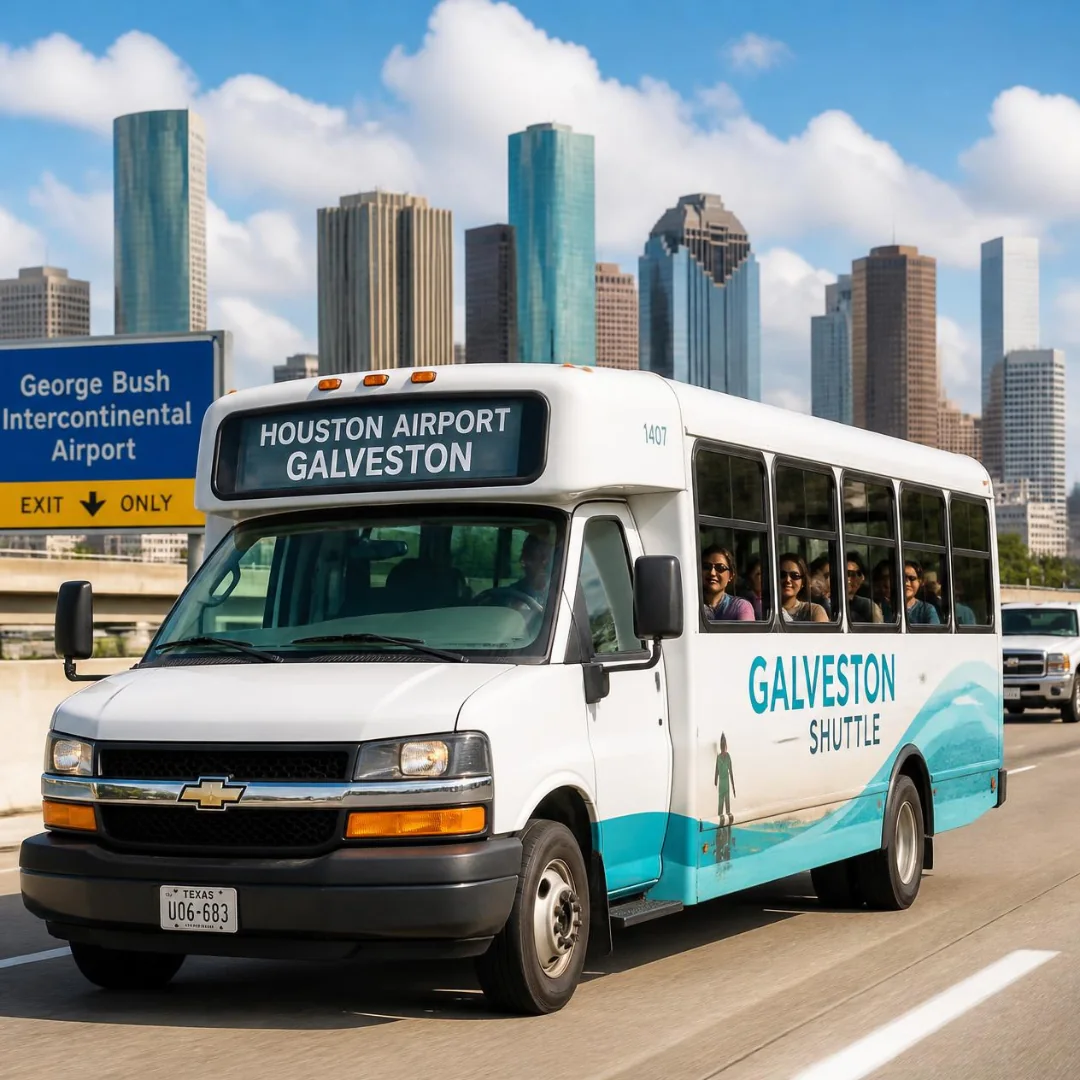
Once you accept there is no bus or train, the real choice is between four options. The full transportation comparison covers all of them side by side; this is the short version.
Shared airport shuttle
A seat in a shared van between the Houston airports and the Galveston cruise terminals. On this site that is a flat $39 per person, one way, from either IAH or Hobby, with standard cruise luggage included and no surge pricing on cruise weekends. You travel with a few other cruisers, and you are dropped at your terminal rather than near it.
This is the closest thing to a bus that exists on the route — a scheduled service, priced per seat, timed around sailings instead of a generic timetable. The practical difference from a bus is that it goes terminal to terminal and it is built for luggage. Details are on the Galveston cruise port shuttle page.
Private transfer
The whole vehicle at a fixed rate, from any address rather than airports only. A black Suburban carrying up to six people runs $249 from Hobby and $257 from IAH, and a 14-passenger Sprinter starts at $590. Priced per vehicle, so it improves as the group grows — for four or more people it stops looking expensive quickly. See private car service and the fleet for vehicle capacities.
Rideshare
Available, and genuinely flexible for timing. Expect roughly $60 to $150 or more one way, with the upper end during exactly the hours you need it — cruise mornings, when hundreds of people want the same trip at once. Driver availability at the terminals for the return leg is unreliable, and there is no accountability if nobody accepts your request. We ran the numbers properly in Uber from Houston to Galveston.
Driving and parking
Straightforward if you have a car in Houston. Port parking runs roughly $20 to $35 a day, or about $175 for a week-long sailing, on top of fuel and the drive itself. For a couple on a seven-night cruise, parking alone costs more than two round-trip shared seats. The shuttle versus rental car and parking guide works through the total, and cruise parking lists the lots and rates.
Cost comparison, one way
| Option | Typical cost, one way | Reaches the terminal? |
|---|---|---|
| Train | Does not exist | No |
| Direct intercity bus | Does not exist | No |
| Multi-leg transit attempt | Low cash cost, 4+ hours | No, needs a final leg |
| Shared shuttle | $39 per seat | Yes |
| Private Suburban, up to 6 | $249 to $317 per vehicle | Yes, from any address |
| Rideshare | About $60 to $150+ | Usually, subject to availability |
| Drive and park | About $175 a week, plus fuel | Yes |
For one or two people the shared seat is clearly cheapest of the options that actually work. From four people upward, private starts to compete on cost and wins on convenience, because it collects you from your door instead of an airport.
If you were hoping for transit because of cost
That is the usual reason for the search, and it is worth addressing directly. The cheapest workable option on this route is a shared seat, and at $39 it is close enough to a bus fare that the transit workaround stops making sense once you count the extra legs and the final taxi.
There is also a cost that does not appear on any fare table: what happens when something slips. Most shared shuttles in this market are non-refundable, so a delayed inbound flight means you lose the fare and pay again for a last-minute alternative. Every shared seat here includes Shuttle Protection at no extra charge — if a delayed or cancelled flight causes you to miss your pickup, you are refunded, and the same applies on the return leg if your ship gets back late. You can also cancel for any reason up to two hours before pickup. That is the difference between a cheap fare and a cheap trip.
If you were hoping for transit because you have no car
Then the shared shuttle is the direct replacement for the bus you were looking for. It runs on a schedule, it is priced per person, it collects from both Houston airports, and it delivers to whichever of the four Galveston cruise terminals your ship is using. No car and no driving required at any point. If this is your first sailing out of Galveston, the first-time cruiser checklist is worth ten minutes.
The bottom line
There is no train to Galveston and no direct bus from Houston to the cruise port. The gap is real, it is about fifty miles, and it is why a whole category of shuttle services exists on this corridor. If the reason you were looking for public transport was cost, a $39 shared seat is the answer. If the reason was not having a car, it is also the answer.
What a bus would have given you is a fixed price, a published schedule, and no need to own a vehicle. A shared seat gives you all three, plus a drop-off at the terminal door and a refund if your flight lets you down. The route never got its bus. It got something that fits a cruise better.
Houston to Galveston distance
Bus or train from Houston to Galveston: common questions
No. Amtrak does not serve Galveston Island and there is no commuter or light rail connection. Amtrak's Sunset Limited calls at Houston, but that still leaves you about 50 miles from the cruise port and needing ground transport for the final leg.
No. There is no direct scheduled intercity bus from Houston to the Galveston cruise terminals. Carriers such as Greyhound and FlixBus sometimes show connecting itineraries, but these involve transfers, sparse departures, and a drop-off at a bus stop rather than a terminal. Check the carrier directly for your date, as thin routes change frequently.
No. Galveston Island Transit runs local routes on the island only. It does not cross the causeway and is not designed for cruise passengers with luggage heading to a terminal.
No. METRO covers the Houston metropolitan area and its southern reach ends well before the Galveston causeway. There is no METRO route or park-and-ride that reaches the island or the cruise port.
A shared shuttle seat, at a flat $39 per person one way from either IAH or Hobby, with standard cruise luggage included. It is the cheapest option that actually delivers you to your terminal, and Shuttle Protection is included at no extra cost.
By road, roughly an hour to ninety minutes depending on your starting point and traffic. Central Houston is about 50 miles from the port, Hobby Airport about 40 miles, and Bush Intercontinental about 70 miles.
Ready to book your ride?
Reserve your $39 protected seats in about two minutes, or call 409.256.4583 for a private quote.
Book shuttle